
Figurative Language in Speech Therapy (+ FREE Download)

Speech-language pathologists working with students who have language disorders know that figurative language skills can be some of the trickiest targets to address in therapy. And trying to explain figurative language can sometimes lead to even more confusion on students' faces. 😵💫
Figurative language is woven throughout the academic curriculum, social interactions, and everyday communication, making its understanding essential for our students' success. Whether you're writing your first figurative language goal or looking to refresh your therapy activities, having a solid understanding of the different types of figurative language and creative ways to teach them can make all the difference.
In this post, we'll break down the key types of figurative language, explore how to write goals for the skill, and share some of the best speech therapy materials to bring these concepts to life in your speech therapy sessions.

WHY SLPs SHOULD TARGET FIGURATIVE LANGUAGE
Figurative language shows up everywhere in students' daily lives—in classroom lessons, books, everyday conversations with friends, and even in teacher directions.
Students with language disorders often have trouble understanding abstract language, such as idioms and metaphors. This includes many children with autism, who often have a difficult time deciphering nonliteral meanings. When students with language disorders take everything literally, they miss important information or may feel confused or left out. This can hurt both their learning and their friendships.
Teaching figurative language also builds important critical thinking skills, like making inferences and understanding context. As students move through elementary school and into middle and high school, they need to interpret metaphors in literature and understand symbolism.
Eventually, students learn to use figurative language as a literary device in their own writing. Without these skills, students may struggle to keep up with grade-level work and show what they know.
TYPES OF FIGURATIVE LANGUAGE
There are several different forms of figurative language, and it can be helpful to target them separately at first. This quick recap will help you explain the common types to your students. Some even include links to video figurative language lessons for you to incorporate in your speech therapy sessions.
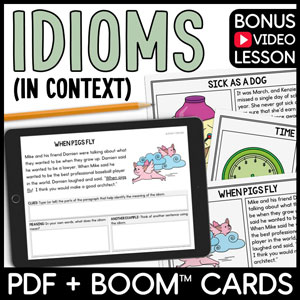
Idioms
An idiom is a phrase that's used to express something completely different than what the words actually mean. For example, if someone says "The test was a piece of cake," they don't mean that the test was actually a dessert. "Piece of cake" is a common expression for something easy.
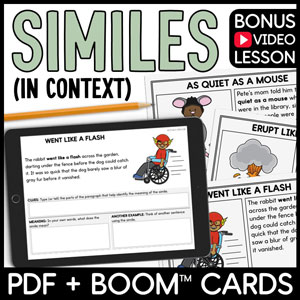
Similes
A simile is a comparison between two things or ideas using the words like or as. An example is, "I slept like a baby last night," where the speaker is comparing how they slept to how a baby sleeps (deeply and/or for a long time).
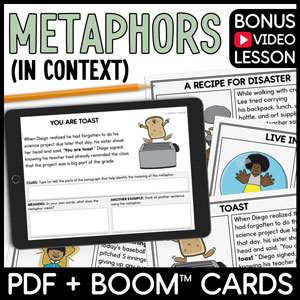
Metaphors
A metaphor also makes a comparison, but without using like or as. Instead, a metaphor states that something is something else, such as "Marisol is a light in the classroom."
Hyperboles
A hyperbole is an exaggeration, usually to make a point or add emphasis. An example is, "I told you a million times to pick up the mess."

Personification
Personification is the use of a human quality (such as an action or feeling) for an animal or inanimate object. For example, "The leaves danced in the air." Obviously, leaves don't dance, but personification was used to describe the smooth movements of the leaves in the wind.
Onomatopoeia
An onomatopoeia is a word that sounds similar to the actual sound it describes. An example is pop, as in, "Each firework made a loud pop in the sky."
After introducing and practicing each type of figurative language, students become better equipped to identify, interpret, and discuss figurative expressions they encounter in both spoken and written language.
FIGURATIVE LANGUAGE GOALS
It'd be impossible to teach every instance of non-literal language that students may encounter. While there are some common proverbs students will likely hear more than once, there are many others that are rarely said or are invented by the speaker.
Because of this, there's no point in memorizing idioms. Therapy time is much better spent encouraging students to identify and use context to determine the overall meaning of what's being said.
The context may be the rest of the words in the sentence or paragraph. But the overall situation – including the feelings, motivations, body language, and tone of voice of others – may also be relevant context clues. Being able to use multiple contexts to identify non-literal meanings is a powerful tool that will benefit your students throughout their lives.
FIGURATIVE LANGUAGE ACTIVITIES
The following helpful materials can be included in language therapy lesson plans for targeting the understanding and use of figurative language.
Explicit Teaching
When first tackling figurative language goals, I suggest explicitly teaching students about figurative language in general and also specific types. As I mentioned, I have several free video lessons to help you explain figurative language and provide examples.
Figurative Language Worksheets
These worksheet activities explore figurative language examples in context and help students visualize meaning. Each one also includes a literal illustration of the expression, which is a fun way to show the contrast between literal and figurative language.

They are perfect for therapy or sending for home practice. Plus, digital versions (Boom™ Cards) are included if you're a teletherapist or if your students respond well to using technology in sessions.
Figurative Language Boom Cards
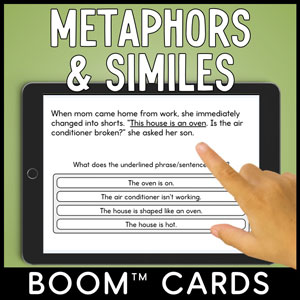
These digital task cards (get them here on Boom) give examples within a paragraph for students to identify the figurative meaning. Multiple-choice answers support students as they learn to identify meanings for each form of figurative language.

Card Activities
There are several quick and easy ways to target figurative language with some basic index cards.
Play memory using cards containing both figurative language expressions and the meaning of each expression.
Write the beginning of a simile (such as "as fast as...." or "as bright as...") on 10-20 and objects or animals on another 10-20. Have students make their own similes using one card from each stack.
Write sentences that include literal meanings on one set of cards. On another set, write sentences that include figurative meanings (for the same sentences or different ones). Have students sort the cards into literal and figurative piles.
Website Games
These websites provide some fun, digital, and teletherapy-friendly ways to target figurative language.
IXL's Hold the Phone game is a fun way to target idioms. It simulates a text conversation in which students select emojis to represent an idiom before selecting its meaning from the choices.
Baamboozle has tons of figurative language games. Most use GIFs, which definitely keep students' attention!
Jeopardy Labs has tons of user-made games, just search "figurative language" or a specific type to find what you need!
Books and Videos
Use books or stories (that include figurative language expressions) to decipher their meanings within the greater context of the text. Goodreads and Epic! each have collections to give you some ideas.
TIPS FOR TARGETING FIGURATIVE LANGUAGE IN SPEECH THERAPY
Here are a few helpful strategies to make teaching figurative language clearer, more engaging, and more effective for your students.
Start with the big picture first.
Before diving into idioms or metaphors, explicitly teach the foundational concept of figurative language. Help students understand that figurative language = nonliteral language and that it's used to add meaning, create imagery, and make language more interesting and expressive.
Teach one type at a time.
Introduce and practice one form at a time. Gradually add more types as students become more confident, and review the types along the way.
Use visuals.
Pictures, simple drawings, anchor charts, videos, and graphic organizers make abstract concepts concrete. Many students need a visual “hook” to anchor the meaning.
I’ve created a simple, free graphic organizer that can be used with text, videos, conversations, or any other activity to record and learn figurative meanings. Download it below to help your students identify types, note context clues, and understand nonliteral language in a clear, organized way.

👇 Get your free figurative language graphic organizer here! 👇
Focus on using context.
Using the context of the situation or text is the bread and butter for learning how to identify figurative language meaning in both social and academic situations, so keep that as the focal point.
Point out the contrast between literal and nonliteral meanings.
Strengthen students' flexible thinking and vocabulary skills by having them explain both the literal and nonliteral meanings of figurative language.
Teach real-world examples.
Using familiar, everyday experiences helps students connect figurative language to meaningful situations, making nonliteral expressions easier to understand, remember, and generalize.
With a strong foundation, engaging activities, and clear goals, students can build the confidence they need to understand and use figurative language successfully.
Supporting figurative language concepts in speech therapy helps students make sense of the nonliteral language they come across every day. As SLPs, we can explain different types of figurative language, break down examples, and give students the tools they need to think beyond literal meanings.
👇 Check out these figurative language activities to use in speech therapy. 👇


📌 Got a speech therapy board on Pinterest? SAVE the love ❤️


Comments